Face to Face With a Wild Chimpanzee: What Chimp Trekking in Kibale Forest Is Really Like
Special thanks to Uganda Tourism Board for their continued support to this initiative
Uganda's most underrated wildlife experience: and why it might be the one you remember most.
You hear them before you see them.
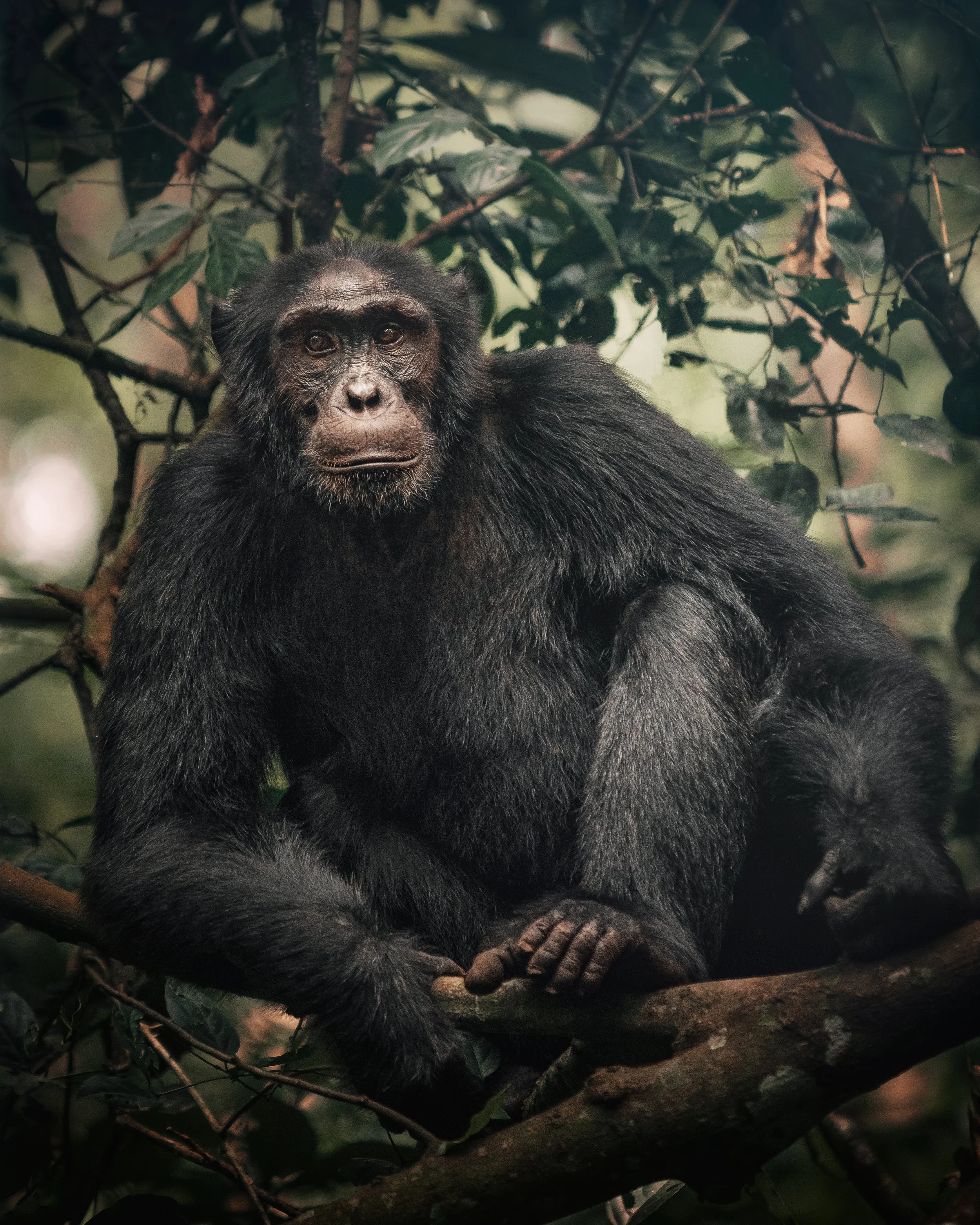
A sound somewhere between a bark and a scream cuts through the forest canopy, then another, closer. Your guide holds up a hand. Everyone stops. And then, about four metres above your head, a chimpanzee drops through the branches, lands on a trunk with a casual thud, and looks directly at you.
Not past you. At you. With something that reads unmistakably as curiosity.
That moment, that eye contact, is what people mean when they say chimp trekking in Kibale changed them. It's not a wildlife sighting in the traditional sense. It's an encounter. And Kibale Forest National Park in western Uganda is the best place on earth to have it.
Why Kibale?
Kibale Forest National Park covers 795 square kilometres of montane and lowland forest in western Uganda. It has the highest density of primates of any forest in Africa, a total of 13 species, including red colobus, grey-cheeked mangabey, L'Hoest's monkey, and olive baboon. But the reason most people make the journey here is the chimpanzees.
Kibale is home to around 1,500 chimpanzees. Several communities have been habituated over decades, meaning researchers and guides have spent years introducing them gradually to human presence until they behave naturally around visitors. The result is an encounter that feels nothing like a zoo and everything like stepping into their world uninvited, and being tolerated anyway.
We share roughly 98.7% of our DNA with chimpanzees. In Kibale, that statistic stops being abstract.
What the Trek Actually Looks Like
Treks depart from Kanyanchu Visitor Centre, the main hub inside the park. Morning sessions start at 8am; afternoon sessions at 2pm. Morning is generally better, as chimps are more active, the light is softer, and the forest is cooler.
Groups are capped at six people per habituated community. This isn't just a conservation measure (though it is that too) it means the experience stays genuinely intimate. You're not watching wildlife through a crowd. You're in it.
Before you set off, a ranger briefing covers the basics: stay seven metres from the chimps at all times (they'll often close that gap themselves, though you can't always control it), no flash photography, no eating near them, stay quiet when the guide signals. Then you head into the forest.
The trek can last anywhere from 30 minutes to four hours depending on where the chimps have moved overnight. Guides carry radio contact with trackers who've been in the forest since dawn, so you're rarely searching blind for long. When you reach the group, you have one hour with them.
An hour sounds short. It isn't. It's enough time to watch a mother nurse her infant, see two males resolve a disagreement with noise and bluster, observe a young chimp attempt to steal fruit from an older one, and have at least one moment of direct eye contact that you will not forget in a hurry.
The Forest Itself
Kibale isn't background scenery. It's part of the experience.
The forest is ancient: some trees are over 200 years old, with buttress roots that tower above your head and canopies that filter the light into something green and diffuse. The path underfoot is soft, occasionally muddy, always shaded. Fig trees are everywhere, which is why the chimps are everywhere, and when the figs are fruiting, entire communities gather in the same tree, and the noise they make doing it carries for half a kilometre.
Bird calls layer constantly overhead: the liquid whistle of the African paradise flycatcher, the territorial rattle of the black-and-white casqued hornbill, the insistent piping of something you can't locate no matter how long you look. Even if the chimps took the morning off, the forest would be worth the walk.
Practical Information
Permits: Standard chimpanzee trekking permits are included in our packages this November, and availability is limited, especially in peak season.
Fitness level: The trek is moderate. You're walking on uneven forest floor, sometimes uphill, sometimes through mud, for up to a few hours. Reasonable fitness is enough. You don't need to be a hiker.
What to wear: Long trousers, long sleeves (for sun and insects), sturdy closed-toe shoes or boots with grip, and a light rain layer. Gaiters are useful in the wet season. Leave strong perfume or cologne at the lodge.
What to bring: Water (at least 1.5 litres), insect repellent, camera (no flash), and a small backpack. Walking poles are optional but helpful on uneven ground.
Kibale as Part of a Larger Journey
Sauti Safari's November 2026 itinerary includes two nights at Kibale Forest, arriving from Murchison Falls in the north. Chimpanzee trekking is the centrepiece of the Kibale leg, booked, permitted, and guided as part of the full eight-night journey, which also takes in four nights at Nyege Nyege Festival in Jinja.
The Part That Stays With You
People come back from gorilla trekking in Bwindi talking about the scale of it: the sheer physical presence of a silverback, the silence, the weight of the encounter. Chimp trekking in Kibale is different. It's louder, faster, more chaotic. The chimps move constantly, argue, play, and occasionally charge past you at full speed without breaking stride.
What stays with you isn't any single dramatic moment. It's the accumulation of small ones. A juvenile hanging upside down, watching you watch it. An older female moving through the undergrowth with total authority. The sound of the whole community calling to each other across the canopy, back and forth, like a conversation you almost understand.
You share 98.7% of your DNA with these animals. In Kibale Forest, the other 1.3% feels very thin.